
The Toronto Maple Leafs have been a postseason staple for nine consecutive seasons. However, that consistency has been marred by an inability to advance past the second round. After a massive culture-altering move this offseason, trading Mitch Marner to the Vegas Golden Knights, the Maple Leafs are now at risk of seeing their playoff streak snap.
The situation is complicated by the recent acquisition of Brandon Carlo. As a result of that deal, the Boston Bruins currently own Toronto's first-round draft pick. However, there is a catch: the pick is top-5 protected. Unless the selection falls within the top five, the Leafs will lose it to their division rivals. This leaves the team with very few options moving forward.
The Case for a Strategic Retool
The lack of control over their own first-round pick puts the Leafs in a precarious position. Ironically, this lack of control is exactly why a retool might be the most impactful move for the franchise right now.
For the Maple Leafs to guarantee they retain this crucial asset, they effectively need to finish in the league's bottom three spots. While this sounds like a lofty task for a roster of this caliber, the standings tell a different story. The Leafs currently sit just two points up on the 29th spot, creating a realistic path for a bottom-tier finish that secures their future.
Over the next few days, I will take a deep dive into what I believe is the best course of action for the Maple Leafs to navigate this crisis.
The Rules of Engagement
In this upcoming series, I will explore potential roster moves while adhering to a strict set of rules to keep the scenario realistic:
The Core Remains Intact: I will not be moving Auston Matthews, John Tavares, or William Nylander. Significant moves involving these players are reserved for the offseason, not in-season panic trades.
Respecting Precedent: All proposed moves will follow NHL precedent established in previous seasons to ensure market value accuracy.
No "Burn it Down" Scenarios: We are not completely overhauling the entire roster and filling holes with inadequate players
Competitive Integrity: The goal is not to strip the roster down to a point where the team cannot compete next season. This is a retool, not a rebuild.
Blueprint for a Toronto Maple Leafs Retool: Strategy, Cap Space, and Extensions
To kickstart this process, I recently took to X (formerly Twitter) to ask fellow Leafs Nation members for their input on a potential roster retool. While the knee-jerk reaction from many was to "blow up the core," that simply isn’t a realistic in-season scenario.
Instead, I have synthesized a practical path forward, incorporating realistic fan suggestions while keeping a close eye on the salary cap. Here is the step-by-step breakdown.
Step One: Establish a Strategy
The primary objective for next season must be to inject speed and competitiveness into the lineup, specifically creating roster spots for emerging talents like Jacob Quillan and carving a development path for Ben Danford.
Secondary to the on-ice product, the goal is asset management. We need to recoup assets that give the team flexibility to be buyers at next year’s trade deadline or stockpile draft capital to replenish the Leafs’ prospect pool. With the philosophy set, we move to the roster mechanics.
Step Two: Housekeeping and Asset Management
The Leafs have six players on expiring contracts heading into next season. Addressing these restricted (RFA) and unrestricted (UFA) free agents is the first priority of any retooling effort.
The Expiring Contracts
Restricted Free Agents (RFA)
Matias Maccelli: $3,425,000
Nick Robertson: $1,825,000
Unrestricted Free Agents (UFA)
Calle Jarnkrok: $2,100,000
Scott Laughton: $1,500,000
Bobby McMann: $1,350,000
Troy Stecher: $787,500
The Verdict: Who Stays and Who Goes?
Of this group, the only three candidates I am interested in extending are Robertson, Laughton, and Stecher.
- Matias Maccelli: Unfortunately, his tenure in Toronto hasn’t panned out as hoped. Moving on seems the best option.
- Calle Jarnkrok: Reports suggest he intends to return to Europe next season, likely closing the book on his NHL tenure.
- Bobby McMann: While McMann has proven to be a useful utility player, he holds the highest potential trade value outside of Laughton. He is a prime candidate to flip for assets.
- Nick Robertson: I view him as a split decision. While my preference would be to sign an extension, he remains a trade candidate if the organization intends to retain Head Coach Craig Berube, who seems intent on misusing the forward.
Contract Extensions: The Numbers
Scott Laughton – Extended
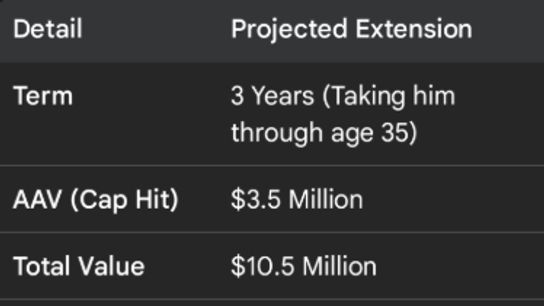
Scott Laughton Contract
With the Philadelphia Flyers currently retaining 50% of Laughton’s salary, a jump to $3.5M may seem steep. However, considering the expected rise in the salary cap, this deal secures Laughton for his age 32-35 seasons and solidifies the team’s bottom-six identity.
While the Leafs could attempt to leverage the "hometown discount" factor to lower the number, $3.5M is my absolute walkaway point.
The Comparables: This valuation aligns with the market for veteran two-way centers:
- Boone Jenner: 4 years / $3.75M per season (Best Comparable)
- Jean-Gabriel Pageau: 6 years / $5.0M per season (Higher offensive production)
- David Kampf: 4 years / $2.4M per season
Troy Stecher – Extended
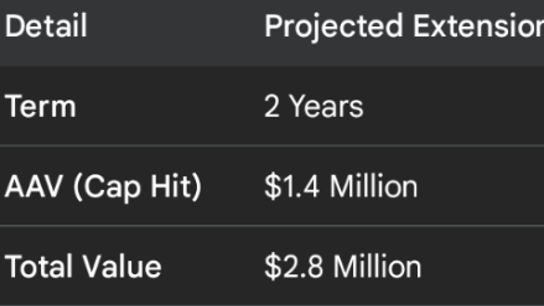
Troy Stecher Contract
Since being claimed off waivers, Stecher has been a breath of fresh air for the Toronto blue line. He has solidified the right side, proving to be a stable partner for Jake McCabe in the absence of Chris Tanev. Stecher offers puck-moving ability but isn't afraid to engage physically or ramp up the intensity when the game demands it.
The Comparables:
- Erik Gustafsson: 2 years / $2.0M per season.
- Jordan Harris: 2 years / $1.4M per season.
While neither player represents a perfect comparable, Harris plays a similar role to Stecher, despite being younger. Gustafsson on the other hand is closer in age and has bounced around the NHL in a similar fashion, but possesses better offensive abilities while Stecher is better defensively.
Tomorrow will bring part two of this series, looking at the moves the Leafs MUST make.