
I've seen an awful lot of people talk about the Ottawa Senators and their play in the defensive zone this season, and rightfully so. To my eye, it's been far and away the most pressing concern for this team. They concede the blue-line too often, and when they're in their zone, it's a combination of an inability to deter the first shot-attempt and extreme inability to exit the zone under pressure.
I think those are two closely-related points. Ottawa's given up more goals than any team this season, and that's largely due to the fact that, despite being an average possession team, they're forced to trade shot for shot because they have such a horrific time at deterring shots (and, consequently, scoring chances and goals). Anecdotally speaking, I've long suspected that the blue-line's dragging the forwards down more than the other way around. Away from Erik Karlsson, there's a gruesome combination of guys who aren't really developed for big NHL minutes yet (Wiercioch, Ceci), don't have the skill set to log anything more than third-pairing minutes (Gryba), are terrible (Cowen), and are old and terrible (Phillips). So, that's that.
It's a thing that I think requires a real thorough investigation and examination, anyway. A lot of people keep pointing out that this team is just woeful in front of the goaltender, but if that was the case (and I'm rather sure it is), it would show in the data, both at the team-level and the individual-level. We know it's true at the team-level. But, I think identifying what guys are contributing to that issue could be really beneficial, beyond just saying it over, and over, and over.
The best way to identify this stuff is really to manually track play in the defensive third; specifically, zone-exit success. That's in progress.
I considered another avenue as sort of an alternate route. What if we could find some way to isolate for defensive-zone play in the underlying numbers? We know the powers of Corsi%, but Corsi% gives us everything -- shots for, shots against, all zone starts against all forms of competition.
What I decided to try today was isolating on strictly defensive zone starts, looking at both how individuals performed after a defensive zone win, and how individuals performed after a defensive zone loss. Both present unique challenges: the first, being able to break initial forecheck pressure, drive through the neutral zone, and create shot-attempts in the team's favor if all goes well; the second, being able to stave off an inevitable blitzkrieg of shots against, either by deterring shots or corralling the puck after the first shot and getting it out of the zone.
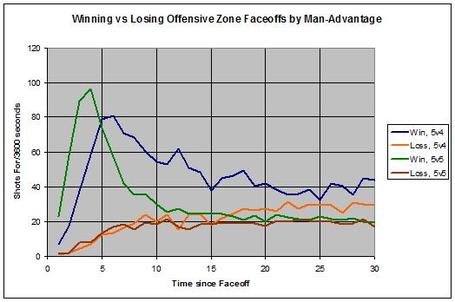
I decided to restrict to thirty seconds based on faceoff win/loss for a variety of reasons, and I may decide to revisit with another number. I think the important thing to note here is that, though the faceoff does dictate where the shots go through the first dozen or so seconds, the "faceoff effect" is well gone by thirty seconds elapsed. Plus, expanding the number a bit allows us to capture whether or not the on-ice group was able to do what it's job is on each and every shift -- drive possession north.
And that, really, is the most important part. Hockey is just a game of brutal repetition, and it's won on the margins. Every five-man group's job is to limit as many shot-attempts against as possible, win the puck, drive possession, generate as many shot-attempts possible. Rinse and repeat, over and over, to win the shot-battle, the scoring-chance battle, the goal-battle long-term.
Here are the results, pulled from the NHL play-by-play sheets. You'll note that the x-axis is the 30-70% band -- I wanted to really capture the marginal differences in players visually, not to mention the ease stuff for labeling purposes. Your best players, theoretically, will sit northeast positionally -- your worst players, southwest positionally.
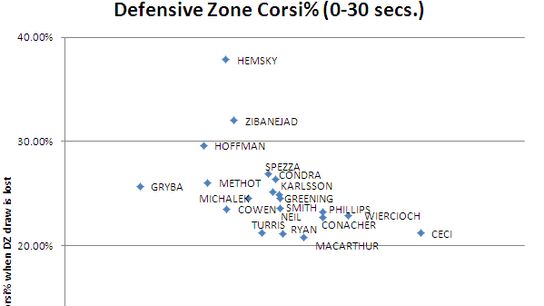
If you believe that there's a team-wide drag going on, I think this is one argument that supports your theory. That cluster of players is three lines worth of forwards, with a few defensemen sprinkled in. I found it fascinating that, despite being so good in the neutral zone, the Turris line wasn't anything out of the ordinary when it came to defensive zone starts. I think this matches what we've observed all season from that group, though -- they're great in the OZ/NZ, but can be hemmed in from time to time. Of course, that group also logs the toughest competition by a fair margin, so in most events, they're not getting cycled on by some third-line grinders.
The names that should stand out after a "loss", obviously, are Ales Hemsky and Mika Zibanejad. With Hemsky, we're really dealing with a miniscule sampling of data -- I hesitated even including him, but Ottawa's going to have to make a decision on him based on a small serving of data anyway, so what the hell.
Zibanejad's the most intriguing. I think there's a funny little thing in hockey about how elite prospects graduate through the NHL ranks. For the most part, it's extremely rare to see a kid just torch teams for goal after goal, unless he's just riding the percentages. What you really want to see for long-term development is ability to drive play and defend off of the puck, especially since his offensive prowess at the junior levels was the reason why he was drafted so high in the first place. It stands to reason that, as the player continues to get more comfortable with his game, the points will come.
There's also the reality that, as the player continues to develop and begins chewing through weaker competition, he'll start facing tougher players. Teams aren't dumb. Kyle Turris has went through basically this exact process, transitioning from a true second-line center project for Ottawa a couple of years ago to probably their most reliable forward on the roster. Every team in the league is cognizant of it, and there was an adjustment period both last year and this year as he learned to work against top trios and top pairings. There's a real argument to be made he's transitioned into first-line/second-line tweener center, and I think the team wants to see him make another jump next season.
I imagine Mika's going to go through something similar over the next couple of years. He's kind of shredding the third and fourth-lines, and at some point, the team's going to be forced to play him more. And, his numbers will take a bit of a step back. The key is to just keep riding the wave, I guess, much like Turris. You'll get to the shore eventually.
The other thing here is -- and not to belabor this mutilated horse any further -- how Patrick Wiercioch compares to the likes of Eric Gryba and Jared Cowen. If there's anything about this graph above, it's trying to capture how guys play in the back-third, and whether or not they can get the hell out of there. I've been carrying Gryba's water as an OK third-pairing guy for some length of time now, but he just doesn't look as impressive as Patrick Wiercioch here. Nor does Jared Cowen, for that matter.
Now, if you're of the mind that Patrick Wiercioch probably isn't the guy that's going to play the most sound defensive hockey or put an opposing forward's head through the glass, you probably think that his Corsi% here is the result of a guy who can pass the puck to someone and *gasp* they receive it, and continue on.
Cody Ceci, who I've sort of been iffy about this year (he's a kid defenseman; 'iffy' is a compliment for these types anywhere around the league), also looks solid here after a win; after a loss, not so much. He's also played a lot with the anchor known as Chris Phillips, so that sort of matters.
So, is it ultimately surprising that a team winning a defensive zone faceoff can use puck-movers to get out of the zone and begin the attack? Well, not really.
So, to wrap it up: this needs a hell of a lot more investigation, and this is really a simplistic first-look at the team's play on the back-end. Zone exit numbers will likely be much more revealing, but I think if anything else is to be argued here, it's that the team as a whole suffers from a drag in the back-third, and not just any one individual line.
(Except for Matt Kassian, who is comically bad at the sport of hockey.)
Thanks to Josh Weissbock for assistance on this.