
Connor Hall will no longer be with the Pittsburgh Penguins. His rights have been relinquished. Hall was the player taken with the third round pick the Penguins acquired from New Jersey in exchange for Beau Bennett. The trade was fine. Bennett for a 3rd round pick was good value at the time. What they used the pick on was wasteful. This isn’t hindsight analysis. Players with such low offensive ceilings are likelier to flame out than find success at higher levels.
Yes, Connor Hall has had some injury issues, but this was the selling point given from Pens Inside Scoop when he was drafted:
on Hall: "Tough as nails. Loves to fight and throw bombs." I think Pittsburgh will love this kid. Good size, long limbs. Plays with snarl. Top fighters in this class. Finishes checks. Compared: McQuaid
Hall has decent mobility and footwork. But isn't going to push the pace or join the rush. More stay-at-home, tough, physical, nasty Dman
I have used this reference before, but I am going to use it again
Here is some information I found on CHL defensemen and their likliehood of playing 100 NHL games based on their offensive ability. I took this information from the Blue Bullet Report
I used 179 first year draft eligible defensemen who were drafted in the top 90 overall, between 1998 and 2010. Of these 179 defenseman, 22% of them have played at least 100 NHL games while maintaining a career ATOI of 18:30. So where is the cut-off?The magic number, for adjusted PPG for a defenseman, is 0.44. Of the 56 defensemen that have an adjusted PPG of 0.44 or better, 46% of them have played at least 100 NHL games while maintaining a career ATOI of 18:30. In comparison, only 11% of the 123 defenseman, with an adjusted PPG of 0.43 or less, have played at least 100 NHL games while maintaining a career ATOI of 18:30. Therefore, the defenseman who have an adjusted PPG of 0.44 are four times as likely to be career 18:30 minute per game defenseman than those that do not. It is clear to see those defensemen who can create offense are more likely to be quality NHL defenseman, compared to those that cannot.
Connor Hall was below the threshold here.
The Penguins second round pick from last year is Zach Lauzon. In his 160 QMJHL games he has 38 points. That is a 0.23 points per game average. Connor Hall’s was, 0.23. These are low ceiling players that should be avoided. It is way better to whiff on a skilled prospect than to settle for below average as a ceiling. It makes no sense to keep doing this.
Zach Lauzon did win the QMJHL’s best defensive defenseman award in 2016-17. He joins this list
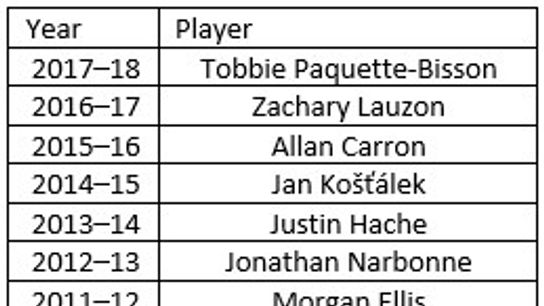
Not exactly a ringing endorsement. Kris Letang is the obvious exception to the rest of the bunch, but based on what I read I don’t think too many people are talking up his defensive abilities these days. The award is useless at predicting future NHL success. Then again, perhaps it is. If you win this award you aren’t likely to find NHL success.
This is something to keep in mind as the Penguins head towards June. They might not have a first round pick (used to acquire Brassard), but they do have a second, third, fourth, two fifths, a sixth, and a seventh round pick. The personnel making those decisions are different than they’ve been in recent memory. Jason Botterill and Randy Sexton have moved on.
The current regime will more than likely look to address a certain position. Pittsburgh’s prospect depth at the defense position isn’t very strong right now. However, for the Penguins to increase their odds of hitting on these picks they need to stop drafting players who show no signs of an offensive pulse in their amateur careers. This isn’t complicated analysis. It shouldn’t be lost on professional teams with a great deal of resources at their disposal. I’m sure they can access Hockeydb.
We’ll see what happens later in June.
Thanks for reading!