
Last time out we completed the top six of the All-Cheap team, and while it was a pretty satisfying looking roster there was plenty of debate about candidates and roles.
You readers made some excellent points, specifically about the roles of Pavelski and Tavares in regards to the money they are paid. So we are going to try and hone in a little bit more on true third and fourth line players who are the best at what they do given their dollar amount.
Check out the top six and the defense before we get moving if you have not already.
As always, ELCs do not count.
3rd line
A good 3C is uber important in today's NHL. Specifically when it comes to getting a prime "Shutdown" candidate. Some team's use their second line centers in this role, others their third. With the way the current team is structured, with Pavelski as 2C, it would not be out of the question to have him in the main shutdown role. However, as many of the readers advocated, if Tyler Johnson were in the 2C role, it would probably fall to the 3C to clean up shutdown duty.
Either way, responsible center depth is something that has helped numerous teams progress deep in the playoffs. A lot of teams are willing to pay an excess amount of money to get that center depth as well. The Los Angeles Kings were spending north of 20 million to put together a center group of Richards, Kopitar, Stoll, and Carter. This is probably one of the more extreme scenarios, but teams do tend to spend on centers.
A good 3C should be able to chip in somewhere in the range of 30-40 points, while playing a defensive oriented game. Good faceoff numbers and penalty kill are generally a big staple to bottom line center games. The time on ice is modest and the matchups generally difficult.
Sometimes, because of that, a good solid third or fourth line center can be hard to value. For example. Paul Gaustad of Nashville is deployed in the most difficult of zone starts in the NHL and has a tremendously bad CF%. He is also paid 3.250 a season. Seems like a terrible investment. However, when you think about just how defensively he is oriented, it eases the usage of other centers in that position. There is cohesion in center depth. You are looking for something very different than your top two centers.
Our group was a surprisingly difficult one to hone in on, simply due to the limited offensive contribution of most bottom line players. You have to sift through a lot of players in difficult matchups and limited ice times to find those that excelled in some smaller facets of the game.
There was one that stood out in particular:
Eric Fehr - $2.00MM
Pittsburgh probably signed the best and cheapest 3C this offseason with Fehr.
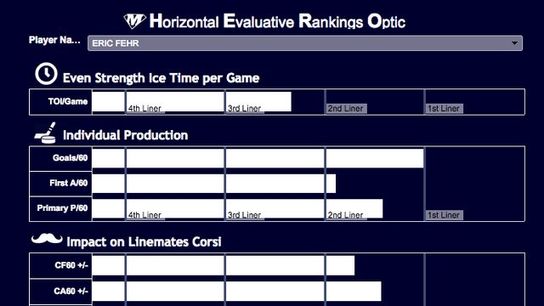
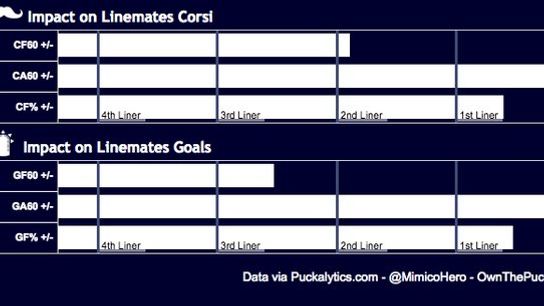
The 29-year old has had three seasons over 30 points in his career, including the past two. He has also scored around 20 goals on two occasions (21 and 19). He logs powerplay and penalty kill time, but is primarily used in defensive situations. He ranked inside the top 40 amongst centers in the amount of defensive positions he was put in. He was inside the top 10 in third line centers used in such a manner. Some players are used in this regard and do not necessarily excel. Fehr, however, does.
He came in at a 47.18 CF% in all situations on the season, but was a 50.14 at even strength. He is inside the top 50 of all centers in the league in Fenwick against, and inside the top 30 in shots against per 60. Fehr also won 52% of his draws last season.
It is this kind of combination of offense and defense that makes for a good 3C, and Fehr is the guy.
It probably hurts most hockey fans to think that Pittsburgh got ANOTHER great center, but they did. And for cheap.
For his wingers we settled on the following two:
Michael Raffl of the Philadelphia Flyers and Daniel Winnik, who just recently signed with Toronto for $2.25 Million a season. Raffl is making a cool $1.1MM AAV for the Flyers.
It should be mentioned that Jakob Silfverberg of the Ducks was definitely in contention for this, but since his current contract negotiations are yet to be complete it was hard to include him. He does not currently have a deal and is a restricted free agent with Anaheim. He just came off his ELC and was one of the better third line wingers in hockey last season. Given his age and contributions, he will get a raise. The same could be said with Brock Nelson of the New York Islanders. Adam Lowry of Winnipeg was also a consideration but is still on his ELC. Melker Karlsson of San Jose was another good name to grab, but there simply was not enough data on the young Swede to know if what he did last season was repeatable.
For the most part, the thing we learned from our research here is this:
If you are a good third liner in the NHL, you got paid for it.
Most decent or average third line players were getting paid around the 2-4 million dollar range given the team circumstance. Some cap floor teams paid more for their bottom line "Character" guys than other. It definitely gave an odd skew to the group of third line players we looked at. Some were Dave Bolland and David Clarkson, while others were dirt cheap value players like Michael Raffl and Nathan Gerbe of Carolina.
The wide variety of players and contract AAVs that exists among bottom line players in the NHL is absolutely astounding. After sifting through most of these, it is easy to make the argument that it is not the big top line contracts that break teams, but the smaller and perhaps overpaid players of the bottom lines that do. Easy to think that when you look at the R.J. Umberger and Tomas Kopecky's of the NHL. Then you have the guys like Joel Ward (3.275 a season) or Michael Frolik (4.3 a season), who are paid very well for what they do, but are also very good at what they do. The difference in contracts to bottom line players is very interesting, at least in this writer's opinion. Compare a Brandon Sutter to an Eric Fehr, or a Darren Helm to a Tuomo Rutuu and it becomes clear how big of a gap exists. With the amount of research and statistics available, there is no reason other than human error or preference with some of the inflated contracts.
Back to Raffl and Winnik.
We have had a short time to get to know the 26-year old Austrian, Michael Raffl. What we have learned in that time however is that he is a pretty darn good hockey player. With 130 NHL games under his belt he has 50 points. Last season he scored 21 goals, only two of which came on the powerplay. He was, in fact, one of Philly's most productive even strength players. He also barely played what you could consider third line minutes. His possession and shot suppression numbers were also very impressive.
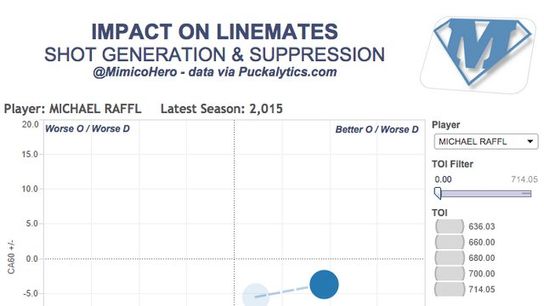

His sample size is small, but not small enough to think this is a one-off season. Consider that Raffl makes just above a million dollars a year, less than almost all third liners in the NHL, and his value only gets better. When Blake Comeau got his recent contract from Colorado, it left the spot wide open for Raffl.
His right wing, the veteran 30-year old Winnik. While 2.25 does not seem like a bargain, he brings a lot to the table in terms of production, defense, and versatility. Winnik can play all three forward positions, kill penalties, and take a draw every now and then. He is not much of a goal scorer, but has touched close to 30 points on three separate occasions, largely due to his assists total. Coupled with two guys that scored around 20 last year, and the third line of Raffl-Fehr-Winnik looks, in theory, like a good one. Winnik is one of those third line players who is paid probably on the bottom portion of the third liner pay scale. Perfect for his inclusion on the team.
Fourth line
The fourth line can be a ragtag group of various types and styles, but they do need to be at least one thing: Responsible. You can not have a fourth line on the ice that is a risky play or that would lose the possession battle on a nightly basis. A bad fourth line is not the worst thing in the world, but if you do not feel comfortable putting them out late in a tie game, then what is the use of having them?
For the All-Cheap fourth line wingers we came across two standouts amongst a sea of players. RW Justin Fontaine of Minnesota LW Tanner Glass
....just kidding
Edmonton's Rob Klinkhammer on left wing
With both, you get good defense, a chip in offense, and basically low risk play all-around. You are not looking for huge production from your fourth line, but a goal here and there helps. For those thinking that Fontaine was not a true fourth line player, he was probably not. HOWEVER, he was deployed as such. Fontaine averaged just over 11 minutes a game, sometimes dipping into single digits, while other times playing on a third liner's minutes. Not bad. He hardly ever played powerplay or penalty kill minutes. It really just depended on flow of the game. Sometimes Fontaine was elevated, sometimes he sat back. The Kings did similar things with Kyle Clifford and Trevor Lewis this year. In the end, Fontaine averaged just around a 4th liner's share of minutes this year. (For comparison Clifford averaged 10:44 on the year)
It is curious that Klinkhammer has been passed around so much in the last two seasons given his fairly strong numbers.
The center came down to a three man run off between defensive specialists. Trevor Lewis of LA, Casey Cizikas of the Islanders, and Jay McClement of Carolina.
Lewis gets a lot of love on the blog for his defensive contribution, and is coming off a great offensive season. However, his 1.525 price tag is high in comparison to the simple 1 million that Cizikas makes. McClement is a nice go between at 1.25 million.
Overall, the Islanders 4C is pretty good. Cizikas put up 18 points last year (9g, 9a) and held pretty good shot and goal suppression numbers. He was a 52% faceoff winner (Better than Lewis) and played some good powerplay time.
In the end though, it is hard to argue with the value you get from Jay McClement, who is widely considered the best fourth line center in hockey. At $1.25 million you get a ton of defensive zone deployments, a great 55% faceoff winning percentage, an average of over two minutes of penalty kill time a night, and last year he posted over 20 points. Yes, Cizikas is cheaper, but we are balancing value versus contribution. McClement is probably the best for value fourth line center in the league that is not on an ELC.
Put it altogether
Michael Raffl (1.00MM) - Eric Fehr (2.00MM) - Daniel Winnik (2.25MM) Rob Klinkhammer (725K) - Jay McClement (1.25MM) - Justin Fontaine (1.00MM)
A $5.25 million dollar third line and a $2.95 million dollar fourth line. Altogether that is $8.20 million dollars spend on a defensive responsible and fairly productive bottom line.
It should be noted you can reserve about $1.25-2.00 million dollars to the two extra forwards the team will carry.
In general you are looking at around $10.00 million for your bottom lines.
For comparison's sake:
This coming season the Rangers will spend about 9 million on bottom line players. Uh oh.
Here is the caveat, five of those players are still on RFA or entry level deals (Etem, Megna, Fast, Miller, and Hayes). So that number is a bit deceiving, although that is the reality of a true set of NHL bottom lines. There are a ton of young players on cheap contracts. We avoided this to be true to player value. Because of this it is hard to find a team that is a true comparison in dollar amounts. However, after a quick perusal of most NHL bottom six groups, 10 million is actually pretty good considering no player is on an ELC, meaning there would be no gigantic leap in pay grade which is to be expected. Each team we looked at had about 3-5 players on RFA deal or ELCs. Nevertheless, most teams were spending in the range of 9-15 million, reasonably, on third and fourth liners. Some teams had some incredibly skewed contracts like that of Dave Bolland, David Clarkson, Tomas Kopecky, or Dustin Brown that widened the range considerably. Comparisons in money, for the most part, were out the window.
(To be fair, we do have some RFA contracts in the forward and defense groups, most notably Tyler Toffoli, Tyson Barrie, Tomas Tatar, and Mattias Ekholm)
Our final roster, with its fair share of arguable inclusions (Joe Pavelski, Tomas Tatar) and exclusions (Victor Hedman, Jaden Schwartz), looks like this:
The All-Cheap Team
Max Pacioretty ($4.5MM) - John Tavares ($5.5MM) - Tyler Toffoli ($3.25MM) Tomas Tatar ($2.75MM) - Joe Pavelski $(6.0MM) - Jiri Hulder ($4.0MM) Michael Raffl (1.00MM) - Eric Fehr (2.00MM) - Daniel Winnik (2.25MM) Rob Klinkhammer (725K) - Jay McClement (1.25MM) - Justin Fontaine (1.00MM)
(2.00MM) Extra forwards
Forwards: 36.225M
John Carlson ($3.967MM) - Roman Josi ($4.0MM) Jared Spurgeon ($2.66MM) - Mattias Ekholm ($1.0375MM) Tyson Barrie ($2.6MM) - Thomas Hickey ($2.2MM) Jordie Benn (700K)
Defense: 17.1645MM
Cam Talbot ($1.45MM) Scott Darling (587K)
Goaltending: $2.037MM*
*(If you wanted to include Steve Mason (4.1), probably the best cheap TRUE starter, raise amount to $4.687MM)
A grand total of: $55.4265 Million dollars.
The cap floor is $52.8 Million dollars and the ceiling is at $71.4 million dollars.
We just barely reached the cap floor with a very competitive roster and almost $16 million dollars in cap space. That's $14 million if you want a proven #1 goaltender to boot. Who wants to plug that one into NHL16 and sim it out? (when it is released of course).
As far as the bottom six goes, did we miss any good ones? Who was left off that should be included? Do you like the look of the overall squad? Was the reasoning in selections justified? Be heard in the comment section!
Follow me on twitter for news and notes about the Kings and the NHL