
For all intents and purposes, the Kings roster is probably as close to set as it can be. They are more than likely done with free agency, and the small amount of roster turnover has created some potential roster battles entering training camp. (A must read)
While depth scoring is not paramount to success in the NHL, it certainly helps to have a scoring by committee feel to the team. With the Kings potential makeup on the bottom lines, is it going to be enough when compared to other successful teams and/or divisional opponents? Mind you, it is not all about scoring goals, it is also about keeping them out of your own net.
The Kings are going to enter training camp with a bottom six and group of depth forwards that looks, more or less, like this:
King - Shore - Brown Clifford - Lewis - Nolan
Weal/Andreoff
On the surface, the third line at least looks very promising. The fourth line is what it is. Lewis is a master at shot suppression, and paired with the right linemates he could even be a catalyst for offense, but with Nolan and Clifford at his wing his job is simple: Defense. Lewis had the second best individual corsi against over 60 rating on the Kings, behind only Marian Gaborik. 43.70 is a pretty impressive corsi against number from Lewis. Clifford was also fairly strong in that department with a 46.37. Nolan was one of just two forwards in the negative differential last year of corsi, meaning when on the ice he generally gave up more possession and chances than he created. Andreoff was the other. In a way, Lewis's main job as a 4C will be to help the line even out overall. All of this information somewhat piggy backs off of our recent breakdown of Trevor Lewis being an outstanding complimentary forward.
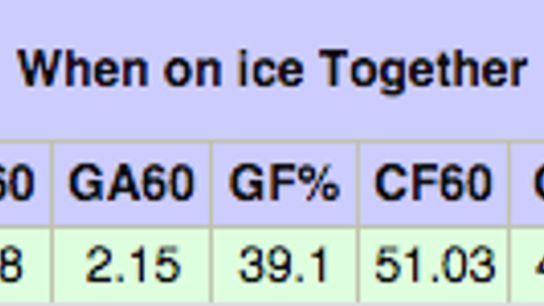
Clifford bounced around with quite a few members of the Kings last season, but logged the most time with Nolan. When the two were on the ice together the stats read as follows:
When Clifford was with Trevor Lewis, here is how things looked.
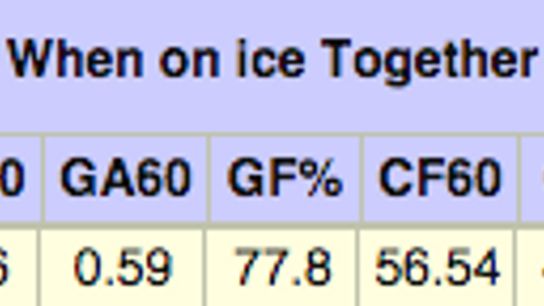
Those are, without a doubt, outstanding numbers all around from the duo of Clifford and Lewis. Take a look specifically at the goals against numbers. They absolutely plummeted to an extreme with Lewis versus with Nolan. Now toss Nolan into the mix along with Clifford and you can get a feel for why Lewis will be an important part of the fourth line.
Nolan and Lewis together:
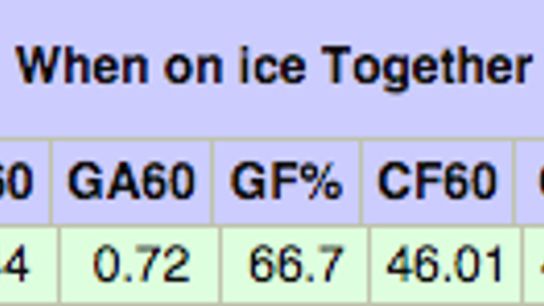
The ice time together was extremely limited, but the same pattern pops up. Lewis was able to stabilize goals against and shot suppression. This caused Nolan to be a break even player possession wise, something he was not able to be over the course of a whole season. It is all about balance.
These are all based on even strength numbers.
Last season Lewis lined up with Clifford the most behind Nolan and Mike Richards. Nick Shore also made several appearances alongside the wingers of Nolan and Clifford, but should be seen in a more elevated role moving forward to next year.
In terms of defense with the third line of King, Brown, and Shore, it is all pretty positive. Dustin Brown and King remain some of the better corsi contributors on the Kings. They rank within the mid part of the lineup in most categories. Nick Shore will be the question mark, but if his progression from game one to game 34 of last year means anything, he should be just fine going forward.

Offensively is where the Kings seem to struggle most, and it is going to be difficult to come by five on five goals from the bottom lines again this year, but there is hope. If you divide the 14 forwards the Kings used last season in half (Sorry folks, did not include David Van Der Gulik), the top half of the list posted 88 goals at evens. The bottom seven posted 35. Good news for scoring distribution, King and Brown were in the top half. Assuming that the Kings can replace the 14 scored by Justin Williams with Milan Lucic, and replace the all important five goals scored between the pair of Richards and Stoll, the scoring should look relatively similar to last season. This is also assuming that Brown can improve a little but on the third line, and that Dwight King can continue to maintain his scoring levels. If all goes according to numbers, the Kings are hoping for around a 60-40 split from goals of top six to bottom six.
The question is, overall was it enough? The Kings were ninth overall in five on five goals for last season and fourth in goals against. Basically, if they maintain those levels again this coming year, things are going to be just fine.
It may seem that the Kings bottom six is exceptionally light on scoring, but that really has not the case.
Compared to other teams in the division, Los Angeles actually boasts a pretty productive group of forwards both offensively and defensively.
Take a look at San Jose for example.
By the same theory of splitting the San Jose forward roster in half, it is way more top heavy than the Kings. With 13 forwards, the top six scorers on the Sharks accounted for 75 of their total 110 goals at even strength from forwards. Of those six and a half players, almost all of them were primarily top six forwards (Pavelski, Couture, Karlsson, Hertl, Burns, Marleau). The bottom lines which included players like Sheppard, Tierney, Goodrow, and Matt Nieto, barely scratched the surface in terms of five on five production. Instead of a 60-40 split, you were looking at more of a 70-30 split from the San Jose roster last season. Also, factor in this: Out of Tierney, Sheppard, Goodrow, Wingels, Desjardins, and Nieto, Only Matt Nieto (Long beach native) was a positive corsi contributor. Where as the Kings had only one regular forward not be on the positive side of the corsi spectrum, almost the entire Sharks bottom six was in the negative. They were not scoring, and they were not keeping the chances down either.
Compared to playoff team like the Anaheim Ducks, the Kings bottom six also compares quite favorably.
It was difficult for Anaheim not to be top heavy with Perry, Beleskey, and Getzlaf all having tremendous years. On many levels, teams like the Ducks, Washington, Pittsburgh or any other team that has a dynamic, world-class, goal scorer can get away with it. 88 goals came from the top half of the scoring column, while 38 came from the bottom half. Cogliano, who was in the top half, was a bottom six player. As was Jakob Silfverberg for most of the season. So In general the Ducks had a fairly even balance overall. Another trend like we saw with the Kings, almost all of their forwards were positive possession players. The departed Devante Smith-Pelly and fourth line center Nate Thompson were the only negative forwards at evens.
Their split ended up being around 65-35, thanks largely in part to Corey Perry and Ryan Getzlaf.
Maroon, Rakell, Jackman, Thompson, Cogliano, Silfverberg, Etem, and Palmieri did a servicable job of rotating in and out of the bottom six and still providing the Ducks with two things: Offensive contribution and defensive responsibility.
When compared to our two closest California rivals, the Kings look very much like a positive roster. The question, in fact, may not be about the depth scoring. It may moreso be about the top end scoring, the special teams, and the defensive scoring. The Kings will definitely have to hope that Lucic can replace the even strength production of Justin Williams, because they honestly cannot afford to lose more production out of the top lines.
There are caveats to the Kings bottom lines remaining successful though: They have to hope Dustin Brown has a bounce back year and they also have to hope Nick Shore takes a step forward. The latter has a couple of insurance policies, and one is named Jordan Weal. Shore still has the ability in his contract to be sent down without being subjected to waivers. If worse comes to worse, the Kings can elevate Lewis or move Weal into the roster for his first taste of action. Dustin Brown, on the other hand, can not afford to have a year of struggles.
Overall, people will probably take a look at the Kings bottom six and say that it is not good enough or looks weak. In fact, it is probably one of the better bottom six sets in the division. The stress is going to be on the top six output. The Kings will go the way of their biggest scoring threats, AKA Jeff Carter, Marian Gaborik, Tyler Toffoli, and Anze Kopitar.
The bottom six will continue to be what it has been, and that is a good thing. They are responsible defensively and chip in offensively at a reasonable clip. You can not ask for much more than that. They are an easy group to pick on in general. They are usually blue collar players who are not going to make flashy, knock your socks off style plays. When scoring is down or the team slumps, it can be easy to look at the bottom six and lament about their contribution. That can be a bit unfair. There will be a few changes to the group this year, but overall no one should be worried about the Kings depth. They have it.
Follow me on twitter for news and notes about the Kings and the NHL
++++I AM CURRENTLY LOOKING FOR ADVERTISERS! If you, or anyone you know would be interested in placing an ad on the blog here at HockeyBuzz then send me a PM!+++++