
Last year a lot of the talk surrounding the Penguins power play wasn’t about the goals they were scoring. It was about the goals they were giving up. Pittsburgh was among the worst in the league at giving up shorthanded goals. I do think the criticism was overblown and related to on-ice save percentage going down the drain, but there are some growing trends around the league the Penguins would be wise to pay attention to.
Penalty killing has become more aggressive and the ability to create offense when shorthanded is seeing an uptick. Meghan Hall gave a presentation at the Rochester Institute of Technology at the Sports Analytics Conference hosted by Ryan Stimson and Matt Hoffman. Her presentation was on this very subject. You can find her slides and full research here
2019 #RITSAC slides and video are now up at @HockeyGraphs https://t.co/smUA6rqrZS
— Ryan Stimson (@RK_Stimp) September 21, 2019
I bring this topic up not because I’m worried about the Penguins giving up more shorthanded goals. I bring it up because I think the Penguins should embrace this trend and try to generate more of their own offense when playing against the other team’s power play. They have the personnel to do it. They just don’t deploy their roster to do so.
Here are the team leaders in time on ice on the penalty kill last year
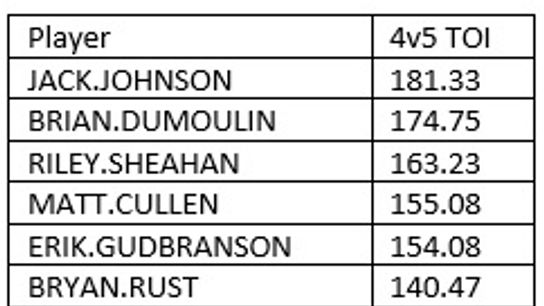
Five of these players are no longer with the team (Sheahan, Cullen, Maatta, Hagelin, Grant) with two players at risk of losing the deployment they received last year (Johnson, ZAR). Outside of Kris Letang there aren’t really any talented offensive players on the list. The Penguins have talented players and they should probably start to think of using more of them. I’m not suggesting the Penguins run Sidney Crosby and Evgeni Malkin into the ground killing penalties, but Mike Sullivan should at least be more open to cycling different players into the rotation. Pittsburgh has a group of forwards who can skate and/or create offense and they should utilize this on the penalty kill. The group includes: Sidney Crosby, Evgeni Malkin, Jake Guentzel, Bryan Rust, Dominik Simon, Jared McCann, Teddy Blueger, and Brandon Tanev. These are eight forwards that can share the responsibilities of penalty killing. Sullivan can read the game situation and decide how to allocate the ice time so he doesn’t burn the players out. One of my biggest pet peeves is when the Penguins take a rash of penalties and you don’t see Crosby or Malkin for almost five minutes of any given period. It is unacceptable. I would also like to see Sullivan utilize TV timeouts and the ends of periods better. There are missed opportunities for Crosby and Malkin to get more ice time while still properly managing their work load.
Let’s look at Meghan’s research on why I want to the Penguins to be more open to playing their skilled players on the PK.
If you look at general ability (proxied by @EvolvingWild’s 5v5 expected goals/60, weighted by time on the PK or PP), offensive skill of forwards on the PK is maybe trending up, while defensive ability of PP players is decreasing. pic.twitter.com/iKMLKAxAKt
— Meghan Hall (@MeghanMHall) September 23, 2019
More teams are playing their better players on the PK because they are starting to realize something I have said forever, good 5v5 players are more than capable of killing penalties. In fact, they are probably better at it than the “specialists… who are just low skilled guys with not much else to add on the team so they throw them in the PK role to eat up some minutes.
We see the amount of shot attempts, shots, and goals going up for teams that are killing penalties.
(Oh also, some manual tracking I did showed that 4F power plays spend a higher percentage of time in their offensive zone compared to 3F, even when you control for the fact that 4F usually starts in their own zone.) pic.twitter.com/1EE1Y2Y5u8
— Meghan Hall (@MeghanMHall) September 23, 2019
One reason for the uptick in PK shot shares could be the growing trend of the four forward and one defense power play. If you’re a good forward killing a penalty it is likely you can make more of your opportunity going the other way with a forward trying to play defense.
The 4F 1D power play setup is better offensively and will have more zone time, but they are susceptible to the PK turning it back the other way. Penguins fans know this.
Oh yeah, and the #CBJ penalty kill set a modern stats era record last season with almost 25% of the unblocked shot attempts (!!!) during 4v5 time. https://t.co/BYsIexZ3qr pic.twitter.com/u24Rlpsiqy
— Meghan Hall (@MeghanMHall) September 23, 2019
The Blue Jackets set a new record for the shot share they had while killing penalties. One out of every four shot attempts when they were killing penalties were actually for them.
According to Matt Cane’s penalty killing aggressiveness research it shows how often the PK team attempted to enter their opponent’s zone with possession. It shows that teams attacked the 4F 1D power play more often and that seems reasonable and logical.
Another side benefit of playing skilled players and pushing the play back against the power play is it starts to put thoughts into the heads of the players on the power play. Their comfort level isn’t as high and their confidence to try the riskier plays will likely go down. By showing you are willing to attack on the PK it may squash some of the power play’s aggressiveness and effectiveness. If the power play team remains aggressive with an aggressive penalty kill it opens up the potential for more wide open plays in either direction.
I think there is opportunity for the Penguins to take advantage of some of the skilled players they have on the roster and do so in situations that maybe they haven’t tried before. Mike Sullivan should be more creative with his deployment of players and the penalty kill can be one of those areas.
Thanks for reading!